Medical Therapy
Finasteride lowers scalp DHT, the hormone driving the recession; topical minoxidil (Rogaine) lengthens the active growth phase. Prescribed and monitored, not guessed.

— Hair Restoration · Atlanta Metro

Flat-rate transplant — up to 3,000 grafts, no per-graft games.
Two decades restoring hairlines across the Atlanta metro.
Of frontal loss responds better when treated before follicles miniaturize.
Seen across our Acworth and Marietta clinics.
— Our Approach
The line moves first because the frontal follicles are the most DHT-sensitive.
A receding hairline is the leading edge of androgenetic alopecia — the conversion of testosterone to DHT gradually miniaturizes the follicles at the temples and frontal scalp. It is biology, not bad luck, and that means it responds to treatment aimed at the cause.
We measure before we prescribe: DHT-relevant hormones, thyroid, ferritin, and vitamin D, plus a scalp assessment. Then we build a protocol — finasteride to lower DHT, minoxidil to extend the growth phase, autologous platelet concentrate to support the follicle environment, and NeoGraft FUE or ARTAS transplant when the follicles up front are truly gone.
Catch the line while the follicles are still alive, and you can usually keep it.
— The Options
Finasteride lowers scalp DHT, the hormone driving the recession; topical minoxidil (Rogaine) lengthens the active growth phase. Prescribed and monitored, not guessed.
A concentrate of platelets from your own blood, microinjected along the hairline to support miniaturized-but-living follicles.
Automated follicular unit extraction relocates DHT-resistant follicles from the back of the scalp to the frontal line — no linear scar, natural angle and density.
Robotic-precision FUE uses digital imaging to select and harvest the strongest follicles, refining graft survival and frontal-line artistry.
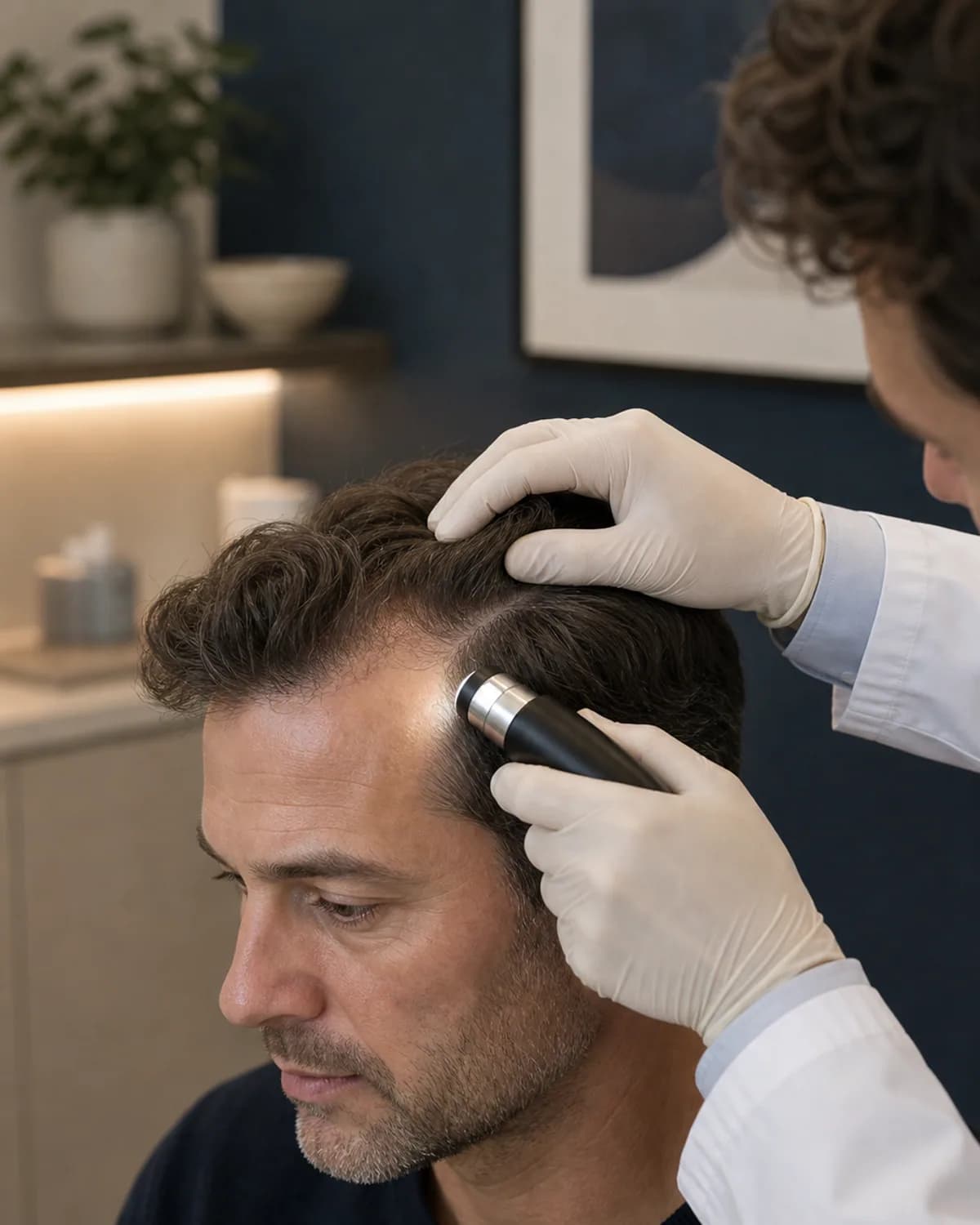
— Mature vs. Receding
Most men settle into a slightly higher "mature" hairline in their twenties — a normal, stable shift. True recession keeps moving: the temples deepen into an M-shape, the hairs thin and lighten, and shed hairs come back finer or not at all.
The distinction matters because it changes the plan. A stable mature line needs nothing but monitoring; an active recession is a window that closes. We use scalp assessment and history to tell which one you have before recommending anything.
— Common Questions
Genetic recession does not reverse without treatment, but it is very responsive when caught early. Finasteride and minoxidil can halt progression and partially restore a thinning frontal line, and autologous platelet concentrate can stimulate follicles that are miniaturized but still alive. Once a follicle is fully gone, only a transplant restores hair there.
A mature hairline rises slightly in your twenties and then holds; a receding one keeps moving, with the temples deepening into an M-shape and regrowth coming in finer. The reliable way to tell is a scalp assessment that looks for follicle miniaturization rather than just hairline height.
For early-to-moderate recession, the strongest evidence is for finasteride plus topical minoxidil, often combined with autologous platelet concentrate. When the frontal follicles are truly gone, NeoGraft FUE or ARTAS robotic transplant relocates permanent, DHT-resistant follicles to rebuild the line. We match the approach to your stage and labs.
As soon as you notice it. Treatment is far more effective at preserving and reviving living follicles than at restoring ones that have already died, so the earliest stage is when medical therapy works best and surgery is least likely to be needed.
At Bubolo Medical, medical therapy and autologous platelet concentrate are a fraction of surgical cost, and our NeoGraft FUE transplant is a flat $6,995 for up to 3,000 grafts — no per-graft pricing. We confirm candidacy and the right path at a free consultation at our Acworth or Marietta clinic.
— Bubolo Care Shop
Provider-grade supplements, skincare, and daily essentials — shipped to your door. Members save up to 50%.
A consultation costs nothing. The conversation may change everything.
Request your free consultation